
Crypto crash games — variants, edge, where to play
Crash isn't one game — it's a category. Stake Originals Crash at 1% house edge is fundamentally a different product to Aviator at 3%, even though the mechanic is identical. This page covers the variants people actually play, ranked on the only signal that matters long-term — house edge — with the operators that carry them as a secondary read.
House edge across crash variants
Lower bar = lower expected loss per round. The 1% in-house variants are mathematically a different category from the 3% third-party field.
- Stake Originals CrashStake
- 1.00%
- BC.Game CrashBC.Game
- 1.00%
- Crash XTurbo Games
- 2.50%
- AviatorSpribe
- 3.00%
- JetXSmartSoft
- 3.50%
- Cash or CrashEvolution
- 4.00%
- Big Bass CrashPragmatic Play
- 4.50%
- SpacemanPragmatic Play
- 5.00%
Per-round expected loss = stake × house edge. Over 1,000 $1 rounds, a 1% edge expects $10 loss; 3% expects $30. Volume amplifies the gap.
How the game actually works
What matters before you press play
What a crash game actually is
A multiplier curve starts at 1.00× and rises until it 'crashes' at a random point. You bet before the round starts and cash out before the crash to lock in your multiplier. Cash out late and you lose the stake. Mechanics are identical across variants; what differs is house edge, round cadence and visual skin.
House edge is the only number that matters
Crash is structurally negative-EV. The only meaningful difference between variants is how negative — Stake Originals Crash runs at 1%, Aviator and Spaceman around 3%. Over 1,000 rounds, that's a 20× gap in expected loss. Pick the variant on house edge first; everything else is paint.
Provably fair vs RNG-certified
Provably fair variants (Stake Originals, BC.Game's Crash) commit to the round outcome before bets close, then publish the seed afterwards so you can recompute the multiplier yourself. RNG-certified variants (Aviator, Spaceman) rely on the provider's lab-tested random number generator — fair, but you can't independently verify any individual round.
Round cadence and how it affects you
Faster rounds = more variance experienced per minute = bigger swings on the same stake. Stake Originals Crash runs roughly one round every 8–12 seconds. Aviator is similar. The shortest cycles favour high-volume play; if you're playing for entertainment, slower-cadence variants protect your bankroll from itself.
Auto-cashout — useful, not magical
Setting an auto-cashout at, say, 1.5× removes the emotional cash-out decision but doesn't change the EV. Lower auto-cashouts (1.3×–1.7×) win more often, lose more cumulatively. Higher auto-cashouts (5×+) lose more often, occasionally cover everything. There is no auto-cashout that beats house edge over time.
Why crypto matters for crash specifically
Crash benefits from low minimum bets and instant cash-out display — both are easier on a crypto operator than a fiat one. Most crypto crash variants accept micro-bets (a few cents in stablecoin); fiat crash games typically have a $1 minimum that defeats the whole low-stakes-high-volume design.
Variants & titles
The games people actually play
Not every variant is the same product. House edge, round cadence and provably-fair status vary meaningfully — pick the variant first, then the operator.
Stake Originals
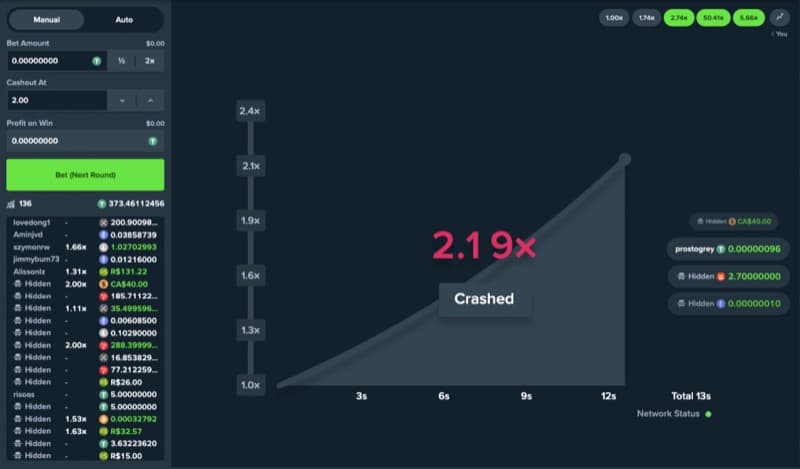
Stake Originals Crash
Provably fair1.00% house edge
The category reference. 1% house edge, provably fair seed reveal, instant round cadence. Played on Stake.
Read Stake Originals Crash review →

Spribe
Aviator
~3% house edge
The third-party reference. The plane-takeoff skin everyone copies. RNG-certified, ubiquitous on operators that don't run their own original.
Read Aviator review →

Pragmatic Play
Spaceman
~3% house edge
Pragmatic's response to Aviator. Spaceman skin, identical mechanics, RNG-certified. Works wherever Pragmatic's catalogue runs.
Read Spaceman review →
BC.Game in-house
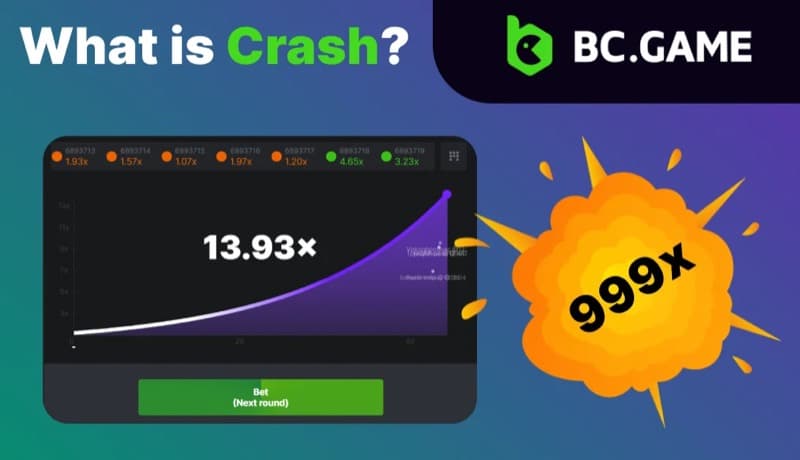
BC.Game Crash
Provably fair1% house edge
BC.Game's own provably fair crash variant. Mechanics close to Stake Originals; plays alongside Aviator and Spaceman in the same lobby.
Read BC.Game Crash review →

SmartSoft Gaming
JetX
~3.5% house edge
Older crash variant with a slightly higher house edge. Distinct multiplier distribution — bigger tails, longer dry spells. Niche, not best-in-class.
Read JetX review →

Turbo Games
Crash X
~2.5% house edge
Cleaner UI than Aviator, slightly tighter house edge. Built for high-volume play with batch-bet support.
Read Crash X review →

Pragmatic Play
High Flyer
RTP 97.0% (Pragmatic standard)
Pragmatic's third crash entry. Biplane theme, advertised max win up to 1,000,000× — the highest theoretical ceiling in the third-party crash field.

Pragmatic Play
Big Bass Crash
~3% house edge
Pragmatic's fishing-themed crash entry. Big Bass IP wrapped around the same Spaceman multiplier engine. Up to €500,000 max win.

SmartSoft Gaming
Cricket X
~3.5% house edge
JetX engine wrapped in cricket theming. Same SmartSoft house edge profile, narrower distribution market.

Evolution
Cash or Crash
~4% house edge
Evolution's live-show crash hybrid. Live presenter, balloon-rise mechanic, scheduled rounds. Different category in practice.
Where to play
Operators that carry these games
The reference operator in crypto gambling — three licences, full sportsbook, provably fair originals.
Five-vertical crypto operator — Casino, Sports, Lottery, Crypto Futures, and BC Originals — built around the BCD staking token (608M staked, $4.46M value).
Three-vertical crypto operator — Casino, Sports, Predict — with 4,000+ games, 50+ sports, $400k monthly prize pool and an Ace's Lounge VIP layer (Rookie → Joker → Club → Heart → Diamond → Spade).
Five-vertical crypto operator — Casino + Sports + Crypto Futures (1000x leverage, $570M 24h volume) + NFT Marketplace + NFT Loans — wrapped around the RLB token. FaZe Clan partner. Trust caveats remain.
Frequently asked questions
Which crash game has the lowest house edge?+
Stake Originals Crash and BC.Game Crash, both at 1%. Aviator and Spaceman are around 3% — meaningful over volume. JetX is higher still. If house edge matters, the choice is between Stake and BC.Game; the rest of the field is 2–3× more expensive per round.
Are crash games provably fair?+
Some are. Stake Originals and BC.Game's in-house variants commit a hashed server seed before the round and reveal it afterwards — anyone can recompute the multiplier and verify the outcome. Aviator, Spaceman, JetX and other third-party variants are RNG-certified by the provider's testing lab but not independently verifiable per round.
Is there a strategy that beats crash?+
No. Crash is structurally negative-EV and no auto-cashout setting changes that. Low cashouts (1.3×–2×) win often but can't outpace cumulative losses. Chasing 100×+ multipliers wins rarely and rarely covers the dry spells. Play for entertainment value on the lowest-edge variant you can find — that's the only edge available.
What's the difference between Aviator and Spaceman?+
Mechanically, almost nothing. Aviator is from Spribe; Spaceman is from Pragmatic Play. Both run at ~3% house edge with comparable round cadence and identical core mechanics. The choice is UI preference and which one the operator carries — most crypto casinos carry both.
Can I play crash games for stablecoins?+
Yes. Stake Originals and BC.Game Crash both accept USDT, USDC and other stablecoins directly — your bet and payout sit in stablecoin without exposing the bankroll to crypto volatility during play. This is one of the practical reasons crypto crash dominates fiat crash: fiat books rarely offer stablecoin stake sizes below $1.
Why do some crash games run at 1% and others at 3%?+
Operator economics. Stake and BC.Game can run their in-house Crash at 1% because they capture full margin and amortise development across millions of rounds. Third-party providers like Spribe (Aviator) need to share margin with the operators that carry the game, so the headline house edge sits higher to leave room for both.