
Crypto Plinko — variants, edge, where to play
Plinko looks simple — drop a ball, hit a multiplier — but variant choice changes the math by 2× over volume. Stake Originals at 1% is fundamentally a different product to Spribe Plinko at 3%. This page covers the variants people actually play, ranked on house edge, with the operators that carry them as a secondary read.
How a Plinko drop is computed
Each row is a 50/50 deflection determined by HMAC-SHA256 output. The example below: 16 rows, High risk, sequence RLLRLRRLRLRLRRLR → slot 9 → 0.2× multiplier.
Same seed + same client + same nonce always produces the same path. Recompute any drop with our Stake Plinko verifier.
How the game actually works
What matters before you press play
How Plinko mechanics actually work
A ball drops from the top of a triangular peg field. Each row deflects it left or right with 50/50 probability. After 8–16 rows it lands in a multiplier slot at the bottom. The slots near the centre have the lowest multipliers; the slots at the edges have the highest. The multiplier you hit determines the payout — stake × multiplier.
Risk modes — Low, Medium, High
Same house edge across modes; what changes is the multiplier distribution. Low risk caps multipliers around 8×–10× but pays out small wins more often. High risk caps at 1,000× on 16-row Stake Originals, but the centre slots are worth less than your stake. EV is identical; variance is wildly different. Pick on appetite for swing, not on expectation.
Row count matters
8 rows: shorter game, fewer multiplier slots, narrower distribution. 16 rows: longer drop, more slots, fatter tails. Higher row counts amplify both the highest and lowest multipliers. Stake's default is 8 rows; the configuration is yours to set per drop.
House edge across the field
Stake Originals Plinko: 1% house edge, the category benchmark. BC.Game's in-house Plinko: also 1%, identical mechanics. Spribe Plinko (third-party): ~3%. BGaming Plinko: ~2.5%. The 1% in-house variants are mathematically meaningfully better over volume.
Provably fair on Plinko specifically
On Stake Originals and BC.Game variants, the seed determines the ball's path through every row deterministically. Server seed committed before the drop, revealed after — anyone can recompute the path and verify the slot. Spribe's verification flow exists but is less surfaced; BGaming publishes their algorithm.
Auto-drop and multi-ball features
Auto-drop runs N rounds at fixed parameters and walks the bankroll up or down without you clicking. BGaming Plinko adds a multi-ball mode — drop up to 1,000 balls programmatically in a single round for simulation-style play. Useful for testing a configuration before committing real volume; useful for burning bankroll fast if you misconfigure it.
Variants & titles
The games people actually play
Not every variant is the same product. House edge, round cadence and provably-fair status vary meaningfully — pick the variant first, then the operator.
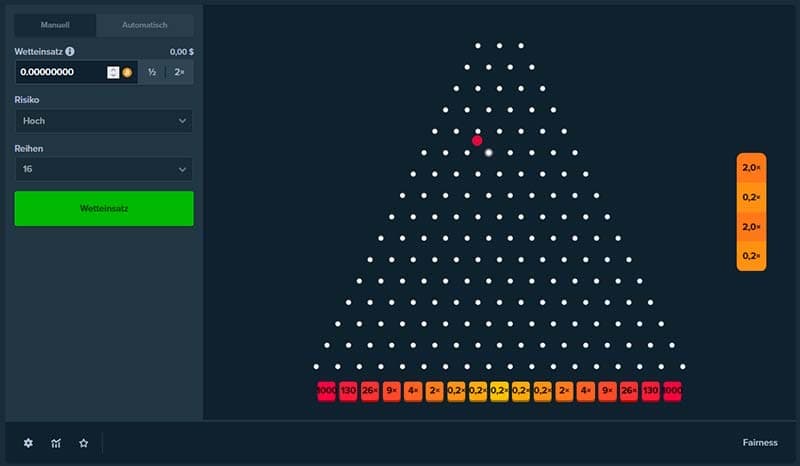
Stake Originals
Stake Originals Plinko
Provably fair1.00% house edge
Category reference. 1% house edge, provably fair seed reveal, configurable rows and risk. The clean implementation.
Read Stake Originals Plinko review →
BC.Game in-house
BC.Game Plinko
Provably fair1.00% house edge
BC.Game's in-house variant. Same 1% house edge, same seed-reveal verification, identical mechanics. Different operator wrap.
Read BC.Game Plinko review →
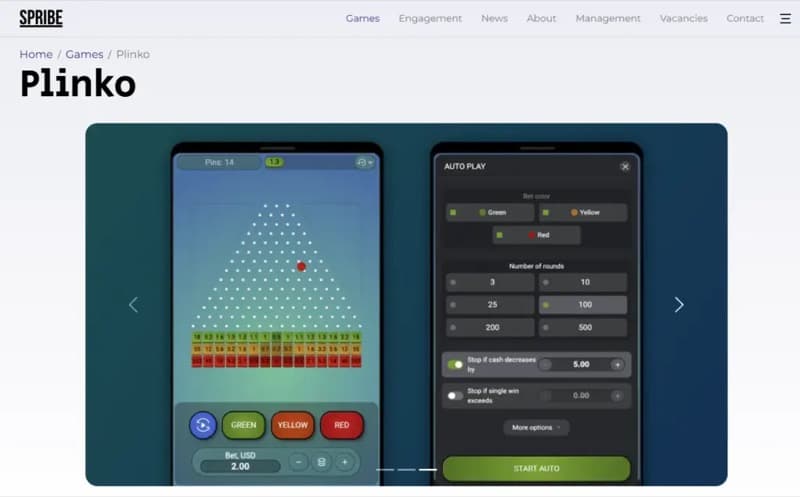
Spribe
Spribe Plinko
~3% house edge
Third-party variant. Ubiquitous on multi-provider operators that don't run an in-house variant. Higher house edge.
Read Spribe Plinko review →

BGaming
BGaming Plinko
~2.5% house edge
Third-party variant with multi-ball drop — drop up to 1,000 balls programmatically per round.
Read BGaming Plinko review →
Where to play
Operators that carry these games
The reference operator in crypto gambling — three licences, full sportsbook, provably fair originals.
Five-vertical crypto operator — Casino, Sports, Lottery, Crypto Futures, and BC Originals — built around the BCD staking token (608M staked, $4.46M value).
New-generation crypto casino with modern UI and 10% rakeback — but a brutal AskGamblers complaint pattern worth reading first.
Three-vertical crypto operator — Casino, Sports, Predict — with 4,000+ games, 50+ sports, $400k monthly prize pool and an Ace's Lounge VIP layer (Rookie → Joker → Club → Heart → Diamond → Spade).
Frequently asked questions
Which Plinko variant has the lowest house edge?+
Stake Originals Plinko and BC.Game's in-house Plinko, both at 1%. Third-party variants — Spribe at ~3%, BGaming at ~2.5% — are meaningfully more expensive over volume play. If house edge matters, the choice is between Stake and BC.Game on operator grounds, not game grounds.
Does the risk mode change my expected return?+
No — house edge is constant across Low, Medium and High. What changes is variance. Low risk gives small frequent wins; High risk gives rare large wins. The cumulative expected loss after 1,000 rounds is identical. Pick on how much swing you can tolerate, not because one mode is 'better'.
What's the maximum multiplier on Plinko?+
On Stake Originals Plinko with 16 rows on High risk, the outer slot pays 1,000×. Medium risk tops out at 130×. Low risk caps at 8.9×. BC.Game's in-house variant matches these. Third-party variants vary; Spribe's tops out lower, BGaming's slightly higher.
Are auto-drop sessions a strategy?+
Auto-drop is convenience, not strategy — it removes the click between rounds but doesn't change EV. The risk is sessions running longer than intended; if you use it, set a session loss limit explicitly before starting.
Can I verify a Plinko drop was fair?+
On provably fair variants, yes. The server seed is committed (hashed) before the drop and revealed after. Combined with the public client seed and nonce, you can recompute the path through every row and verify the multiplier slot matches what was paid. Stake and BC.Game both expose this.
Why does row count matter?+
More rows = more deflection points = wider multiplier distribution. 8 rows gives a tighter outcome range; 16 rows fatter tails on both sides. Higher rows amplify both the centre's negative-EV slots and the edges' high multipliers. Same house edge, different shape.