
Skip to content
CryptoGamblingHub.org
Stake OriginalsPlinkoUpdated April 2026

Stake Originals Plinko review

The reference Plinko implementation. 1% house edge, configurable rows and risk, provably fair seed reveal.

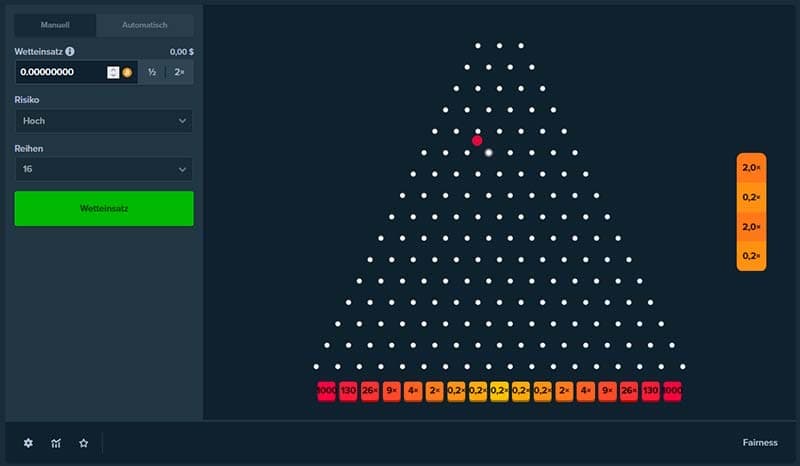
Stake Originals Plinko is the Plinko everyone else's variant gets compared to. 8–16 row configurable, three risk modes, multiplier ceilings published explicitly, and a per-drop seed-reveal mechanism that lets you verify any specific outcome. ~3,000 concurrent players during peak hours — meaningful liquidity.

Stake Originals Plinko thumbnail

Verdict

1% house edge with cryptographic per-round verification is the strongest combination available in the Plinko category. BC.Game's in-house Plinko matches the numbers; third-party variants don't. If you're choosing on math alone, Stake Originals or BC.Game; the choice between those two is operator-level.

Key facts

House edge
1.00%
RTP
99.00%
Provably fair
Yes — server-seed commit/reveal per drop
Rows
8–16 configurable
Risk modes
Low / Medium / High
Maximum multiplier
1,000× (16-row High); 130× (Medium); 8.9× (Low)
Minimum bet
$0.10 equivalent
Available at
Stake exclusively

Full review

How a single drop works

Pick a bet size, a row count (8–16) and a risk mode (Low/Medium/High). Click drop. The ball falls through the peg field — at each row it deflects left or right with 50/50 probability — and lands in one of N+1 multiplier slots (where N is the row count). Stake × multiplier is your payout.

Each row deflection is determined by the seed chain: server seed (hashed and committed before the drop), client seed (publicly visible, controllable by you) and round nonce. After the drop, the server seed is revealed. Combined with the public algorithm, anyone can recompute every row's deflection and verify the final slot.

Risk modes — variance only, not edge

Low risk: centre slots pay 0.5×–1.6×, outer slots pay 5.6×–8.9×. Medium-frequency wins with low magnitude. Boring if you like swing; safer for bankroll preservation.

Medium risk: centre slots pay 0.4×–1.4×, outer slots pay 13×–130×. Wider distribution, more visible volatility.

High risk: centre slots pay 0.2×, outer slots pay up to 1,000× on 16 rows. Most rounds are negative; the rare big hits cover everything. Pure variance play.

House edge is identical across modes — the multiplier table is calibrated so cumulative expectation is 1% loss regardless of mode. The decision is purely about how much swing you want to experience.

Row count effects

8 rows: 9 multiplier slots, narrower distribution range. Faster rounds, tighter outcomes.

16 rows: 17 slots, wider range with extreme tails. Slower drops (visually slower; the deflection animation runs longer), more dramatic outcomes per drop.

Higher row counts amplify both the centre's negative-EV slots and the edges' multipliers. Combined with High risk and 16 rows, you get the highest variance in the category — most drops lose, occasional drops pay 100×+.

Auto-drop and bankroll burn rate

Auto-drop runs N drops at fixed parameters. Useful for session-length play; risky if you misread the variance. A 100-drop auto session at $1 stake on High risk 16-row drops can lose $90 quickly if the rare-tail multipliers don't appear in those 100 drops.

If you use auto-drop, set a session loss limit. The Plinko UI doesn't enforce this — you have to discipline yourself. Treating Plinko as a slow drip-feed of small losses is the right framing; the rare big multipliers are the entertainment value, not the strategy.

Verification flow

After any drop, click 'Verify' on the round in the bet history. Stake reveals the server seed and shows the algorithm: hash(server_seed + client_seed + nonce) → row-by-row deflection sequence → final slot. Public input plus public algorithm equals reproducible output. If the verification disagrees with what was paid, dispute escalation has cryptographic proof attached.

This is the strongest fairness guarantee available in any RNG-driven game. It does not protect against operator-level concerns (KYC, withdrawal verification) — those are wrapping concerns, not game concerns.

Where to play

Operators that carry Stake Originals Plinko

Stakecasinosportsbookpoker

The reference operator in crypto gambling — three licences, full sportsbook, provably fair originals.

Browse more plinko or see all game reviews.

Frequently asked questions

Is Stake Originals Plinko provably fair?+

Yes. Server seed hashed and committed before the drop, revealed after. Combined with the public client seed and round nonce, anyone can recompute every row's deflection and verify the final slot matches what was paid.

What's the highest multiplier I can hit?+

1,000× on a 16-row High risk drop, in the outermost slot. The probability is roughly 1-in-65,000 — high enough to see occasionally, low enough that chasing it loses money on average.

Does Low risk Plinko ever win?+

Yes — Low risk wins frequently at small magnitudes. Outer slots pay up to 8.9×; centre slots pay 0.5×. Cumulative expectation is still negative (1% house edge), but the experience is many small wins punctuated by small losses, not the dramatic swing of High risk.

Can I play Stake Originals Plinko on mobile?+

Yes. Stake doesn't have a native app — the mobile web build is the product. Plinko works at full functionality on mobile browsers, including auto-drop and seed verification.

Why is Stake's Plinko 1% when most third-party Plinkos are 3%?+

Stake captures the full operator margin in-house and amortises development across millions of drops, so it can run the game at a tighter house edge. Third-party providers like Spribe need to share margin with the operators that carry the game, which forces a higher gross house edge to leave room for both parties.